Maybe you’ve been eating soup while everyone else at the table digs into steak, or you’ve learned to laugh with your hand over your mouth. If most of your teeth are failing or already gone, whole mouth dental implants can give you a full set of teeth that stays put, so you can stop working around your smile.
At MoArk Dental & Implants, we help patients from Thayer, MO, Walnut Ridge, AR, and Kennett, MO weigh this option every week. This guide walks through how whole mouth implants work, the types we offer, what recovery is really like, and how cost and financing fit in.
What Whole Mouth Dental Implants Are
Whole mouth dental implants replace an entire set of teeth, top, bottom, or both. Instead of resting on your gums like traditional dentures, the new teeth are anchored to implant posts placed in your jawbone. Those posts act like the roots you lost.
That anchor is the whole difference. Because nothing is floating on your gums, the teeth don’t shift when you talk, cough, or bite into an apple. Most people say they stop thinking about their teeth at all after a while, which is exactly how it should feel.
Benefits of Whole Mouth Dental Implants You’ll Notice Day to Day
Choosing whole mouth dental implants comes with a few big advantages: a fuller, more natural appearance, much stronger chewing, and real long-term health benefits for your mouth.
The bone benefit is the one people don’t hear about enough. When teeth are missing, the jawbone under them stops getting stimulation and slowly shrinks. Over the years, that can make the face look sunken and make dentures fit worse and worse. Implants put pressure back into the bone every time you chew, which helps maintain jawbone integrity and prevent bone loss.
Then there are the everyday wins. You can order what you actually want at a restaurant. You can talk on the phone without a lisp or a click. You can wake up, brush, and get on with your morning instead of soaking a set of teeth in a cup.
Types of Full Mouth Dental Implants We Offer
Not every mouth is the same, so there isn’t one approach that fits everyone. These are the main options our team uses.
The All-on-X System
All-on-X places a full arch of teeth on a small number of implants, usually four or more, angled to make the most of the bone you have. It’s efficient, it often avoids extra procedures, and it’s the route many full-arch patients end up taking.
Zygomatic Implants for Upper Jaw Bone Loss
Some patients have lost so much bone in the upper jaw that regular implants have nothing to hold onto. Zygomatic implants are longer and anchor into the zygoma, or cheekbone, instead. For people who’ve been told they’re “not a candidate,” this can open a door that seemed closed.
Yomi Robotic Implants
Yomi is a robotic guidance system that helps our team place each implant at the exact angle and depth that was planned. Think of it as a steady second set of hands. It improves the precision and predictability of placement, which matters a lot when several implants have to line up under one full arch.
How the Whole Mouth Implant Process Works at MoArk Dental & Implants
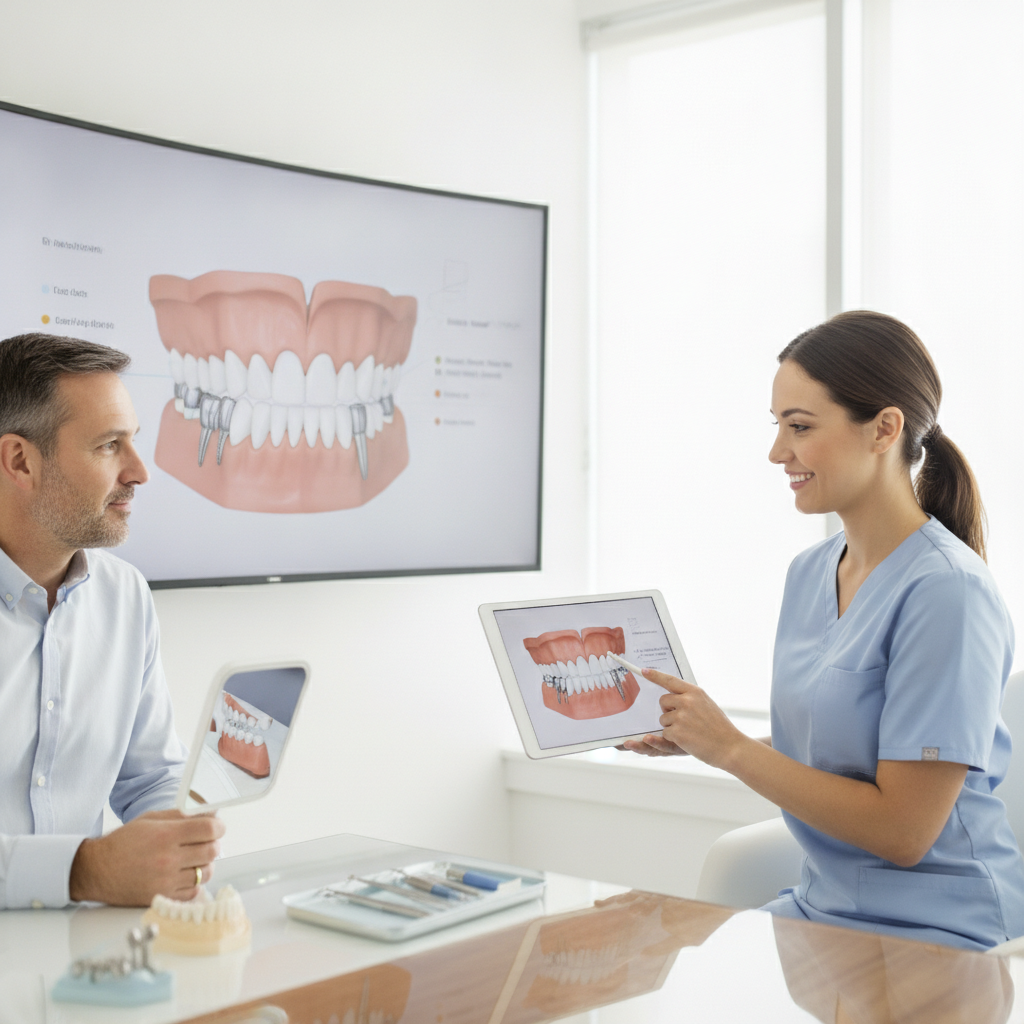
Everything starts with a consultation. We look at your mouth, take imaging, review your health history, and listen to what’s bothering you most, whether that’s loose dentures, pain, or not liking your smile in photos.
From there, we build a personalized treatment plan. The procedure itself happens in several steps, including implant placement and the fitting of your new teeth. Sedation is available, so you don’t have to white-knuckle your way through it, and our in-house lab lets us design and adjust teeth without sending everything across the country.
What to Expect During Recovery
Recovery from whole mouth dental implants happens in stages. The first few days to a week are the most noticeable: some swelling, some soreness, and a soft-food diet. Prescribed or over-the-counter medication usually keeps discomfort under control, and many people are back to light routines within a few days.
The longer phase is quieter. Over the following months, the bone grows around each post. Your follow-up visits are about ensuring implants integrate with the bone the way they should. A simple tip that helps: stock your fridge with yogurt, eggs, soups, and smoothies before your procedure day so you’re not hunting for soft food when you’re tired.
Comparing Whole Mouth Implant Options With Partial Implants and Dentures
Whole mouth implants offer clear advantages over partial implants and traditional dentures when most of your teeth need replacing. They give better support, a more natural look, and stronger function.
Partial implants make sense when you still have healthy teeth worth keeping. Traditional dentures cost less up front, but they rest on the gums, can slip, and don’t stop bone loss. If you’re stuck between options, that’s a normal place to be, and it’s exactly what the consultation is for.
Costs and Financing for Whole Mouth Dental Implants
If the price of whole mouth dental implants makes you nervous, that’s understandable. The cost depends on several factors, including the type of implants chosen, how many arches you’re treating, and whether you need extra steps like bone grafting. MoArk Dental & Implants offers flexible financing options to make treatment more accessible.
It also helps to think about the long run. Dentures need relines, adhesives, and replacements over the years. Implants are a bigger investment up front, but for many people they end up being the steadier choice. We’ll walk you through the numbers before you decide anything.
FAQs About Whole Mouth Dental Implants
Who is a candidate for whole mouth dental implants?
Most adults in good general health with stable gum tissue and enough bone can qualify. If bone is limited, there are often ways around it, which we cover below. A consultation and imaging tell us for sure.
How long do whole mouth dental implants last?
With good daily care and regular checkups, dental implants can last for decades. The teeth attached to them may need repairs or replacement at some point, just like any restoration that handles years of chewing.
Are dental implants safe?
Dental implants are a safe, well-established treatment that dentists have used for decades. Like any surgery, there are risks, and we go over them with you, along with your health history, before anything is scheduled.
What if I don’t have enough bone for implants?
Options like bone grafting can rebuild areas where bone has thinned. For the upper jaw, specialized implants such as zygomatic implants may let you skip extensive grafting altogether.
How do I care for my dental implants?
Care looks a lot like caring for natural teeth: brushing twice a day, cleaning under and around the bridge, and keeping up with dental checkups so small problems get caught early.
Smiling Freely Again
You’ve probably spent a long time planning meals, photos, and conversations around your teeth. Whole mouth dental implants can bring back your smile and your ability to eat what you love without that worry in the back of your mind.
When you’re ready, schedule a consultation with the team at MoArk Dental & Implants. We’ll look at your options together, answer every question, and help you decide if whole mouth dental implants are the right next step for you.